> For the complete documentation index, see [llms.txt](https://docs-v4.venus.io/llms.txt). Markdown versions of documentation pages are available by appending `.md` to page URLs; this page is available as [Markdown](https://docs-v4.venus.io/technical-reference/reference-liquidity-hub.md).
# Liquidity Hub
The **Venus Liquidity Hub** is a per-asset ERC-4626 allocator vault. A lender deposits a single asset, the Hub routes it across Venus yield families (**Core**, **Flux**, **FRV**) under a governance-set policy, and returns a yield-bearing share token. Yield accrues through a **rising exchange rate** (one share = X underlying), never by rebasing. There is one Hub per asset, with no cross-asset coupling.
For the user-facing introduction, see [Liquidity Hub](/whats-new/liquidity-hub.md) under *What's New*.
## Architecture
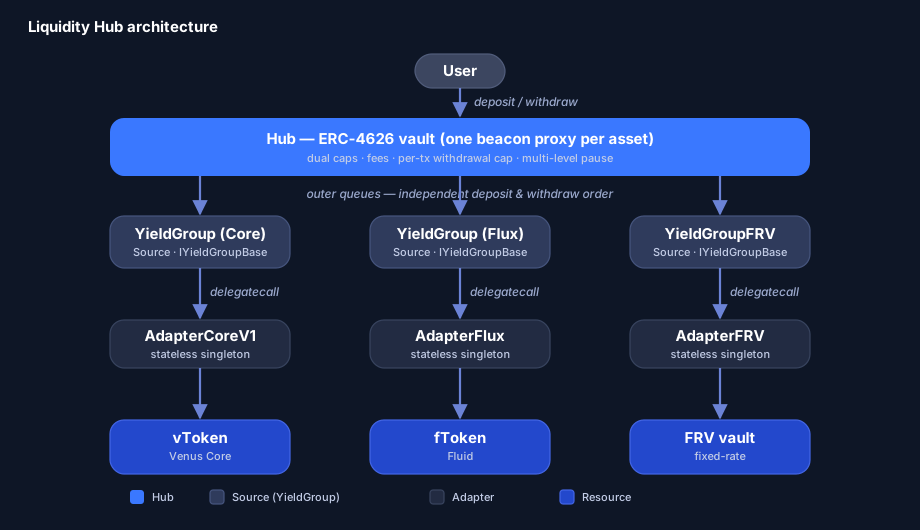
Routing is three-tiered. The Hub depends only on the `IYieldGroupBase` interface and never reaches past a Source into the underlying market.
* **Hub** — the ERC-4626 entry point (one beacon proxy per asset). Holds the Source registry, the two outer routing queues, dual caps, the per-transaction withdrawal cap, the fee parameters, and the multi-level pause flags. It exposes **no APY view** — spot APY is read per-Source from `YieldGroup.spotAPYBps()` and must be aggregated off-chain.
* **YieldGroup (Source)** — aggregates one or more *resources* of a single protocol family behind the uniform `IYieldGroupBase` boundary, and owns its own inner deposit / withdraw queues and per-resource registry.
* **Adapter** — a stateless singleton translating between a YieldGroup and one protocol ABI. Mutating calls run via **delegatecall** so receipt tokens land on the YieldGroup; one deployment per ABI family serves every YieldGroup.
* **Resource** — the underlying market or vault that holds the capital (a Venus Core vToken, a Fluid fToken, or a Fixed-Rate Vault share).
> **Terminology.** The PRD calls the grouping layer a *Source*; the code names the contract a *YieldGroup* and the Hub-facing interface `IYieldGroupBase`. There is no `ISource` type in the Solidity — "Source" survives only in deployment-artifact aliases (`CoreSource_USDT`, `FluxSource_USDC`, `FRVSource_U`). PRD *Product / Vault* = code *Resource*.
## The three yield families
| | **Core** | **Flux** | **FRV** |
| ------------------------ | -------------------------------------- | ----------------------- | ------------------------------------- |
| Underlying protocol | Venus Core lending | Fluid Lending | Venus Fixed-Rate Vaults |
| Resource / receipt token | vToken (Compound-style) | fToken (ERC-4626 share) | FRV vault share (ERC-4626) |
| Deposit / withdraw call | `mint` / `redeemUnderlying` | `deposit` / `withdraw` | `deposit` / `withdraw` |
| Spot APY source | `supplyRatePerBlock` × `blocksPerYear` | Fluid `LendingResolver` | vault `fixedAPY` (Fundraising / Lock) |
| Lifecycle constraint | none | none | 11-state machine |
| Wired at launch | ✅ vToken registered | ✅ fToken registered | ❌ Source registered, no resource |
**FRV carries no resource at launch.** An FRV Source is deployed and registered on every Hub with its caps set, but no Fixed-Rate Vault instance exists for USDT / USDC / U on BNB Chain yet, so the onboarding proposal calls `addResource` on the Core and Flux Sources only. FRV is therefore kept out of the outer deposit queue entirely and placed **last** in the outer withdraw queue — not because it can serve withdrawals, but because `setOuterWithdrawQueue` rejects a queue that omits a registered Source with non-zero `totalAssets()`, and that total counts idle balance: omitting FRV would let a 1-wei donation permanently block the Operator from reordering the queue. That follow-up was [VIP-657](https://app.venus.io/#/governance/proposal/657?chainId=56): it registered the Solv (Ceffu custody) vault on the USDT Hub's FRV Source and the Asseto CASH+ vault on the U Hub's FRV Source, and raised their FRV percentage caps from 30% to 50% of TVL; the USDC Hub's FRV Source remains unwired. FRV is still absent from the outer deposit queue, so it is filled only by the Operator's `reallocate`.
## Contracts
* [**Hub**](/technical-reference/reference-liquidity-hub/hub.md) — the ERC-4626 entry point: routing flows, dual caps, per-tx withdrawal cap, fees, multi-level pause, Operator reallocation, and the full Solidity API.
* [**Yield Groups**](/technical-reference/reference-liquidity-hub/yield-groups.md) — `YieldGroup` (the generic router, deployed twice: once as the Core family, once as Flux) and `YieldGroupFRV`: the `IYieldGroupBase` implementations, per-resource registry / queues / caps, and the FRV lifecycle.
* [**Adapters**](/technical-reference/reference-liquidity-hub/adapters.md) — `AdapterCoreV1`, `AdapterFlux`, `AdapterFRV`: the stateless, delegatecall-dispatched protocol translators.
* [**Interfaces**](/technical-reference/reference-liquidity-hub/interfaces.md) — `IYieldGroupBase` (with its family extensions `IYieldGroup` and `IYieldGroupFRV`) and `IResourceAdapter`, the boundary contracts.
* **`Migrator`** — a stateless, permissionless, non-upgradeable helper for one-click migration of a Venus Core position into a Hub (`migrateFromCore` / `migrateFromCoreBNB`).
**`HubRegistry`** — one per chain, the canonical directory of deployed Hubs. Governance calls `addHub(address)` / `removeHub(address)` (both ACM-gated); everyone else reads `hubForAsset(address)`, `assetForHub(address)`, `isHub(address)`, `getHubs()` and `getHubsCount()`. It emits `HubAdded` / `HubRemoved`, and an indexer should seed from state on `HubAdded` rather than relying on log ordering. Each asset may have at most one Hub (`AssetAlreadyHasHub`).
## Key features
* **Atomic-or-revert** deposits, withdrawals, and reallocations — no partial fills.
* **Dual caps per Source** (absolute amount and percentage of Hub TVL; the stricter binds) plus an optional per-resource cap and a per-transaction withdrawal cap.
* **Multi-level pause** — Hub, Source, or single resource, each independent.
* **Reentrancy-guarded value paths** — every entry point that moves assets is `nonReentrant`: `deposit` / `mint` / `withdraw` / `redeem` / `reallocate` / `emergencyReallocate` / `accrueFees` / `sweep` on the Hub, and `deposit` / `withdraw` / `depositResource` / `withdrawResource` / `sweep` on each YieldGroup. The ACM-gated admin setters are not individually guarded; they rely on ACM gating instead.
* **Asymmetric permissions** — governance holds every gated function except `reallocate`; tightening (pause, lower a cap) is additionally Operator-accessible, and pausing is delegated further to a no-delay Guardian multisig, while loosening (unpause, register a route, raise the withdrawal cap, set fees) stays governance-only. The exceptions are `raiseYieldGroupCap` and `raiseResourceCap`, which the Operator also holds so it can open headroom ahead of a rebalance. All gated by `AccessControlManagerV8`.
* **Stateless shared adapters** — zero storage, delegatecall dispatch; a new protocol family needs only a new adapter, not a Hub change.
* **Fees off at launch** — management and performance fee machinery exists but ships at `0/0`.
## Deployment
The Hub uses a **beacon-proxy model**: one `UpgradeableBeacon` per family per chain (Hub, Core, FRV, Flux), each owned by governance — upgrading a beacon upgrades every vault of that family atomically; per-asset instances are beacon proxies. Deploy scripts only deploy and initialize the proxies; **ACM wiring, `addYieldGroup` / `addResource`, and queue configuration are separate governance (ACM-gated) actions**.
`HubRegistry` is the exception: it is a chain-level singleton behind a **`TransparentUpgradeableProxy`**, not a beacon proxy, so it is upgraded independently of every Hub. On BNB Chain mainnet that proxy is administered by Venus's shared `DefaultProxyAdmin`, the same one that administers the core pool and isolated pools; the BSC testnet deployment predates that decision and still carries a registry-specific `ProxyAdmin`.
v1 targets **BNB Chain**, launching with three assets: **USDT**, **USDC** and **U**.
The contracts are **deployed on BNB Chain mainnet**. Deployment only creates and initializes the proxies — the governance proposal that onboards them grants the ACM roles, registers each Hub with the [HubRegistry](#contracts), wires the resources and queues, and seeds each Hub with a bootstrap deposit. Until that proposal executes, the Hubs are deployed but unwired.
#### BNB Chain mainnet (chain ID 56)
| Asset | Hub |
| ----- | -------------------------------------------- |
| USDT | `0x18AfDACF30F8671021dec4b78297E39d2FE87226` |
| USDC | `0x9D2D9592cF8DFbf59107fAab703d08494BE14617` |
| U | `0x0e5AA174d4F31b757a237eb1999DE151596788B0` |
`HubRegistry` is deployed at `0x6D93Fd479f2d37445CFBe132412e316a0364acc2`. Prefer resolving Hub addresses through it rather than hard-coding them. The [Deployed Contracts](/deployed-contracts/liquidity-hub.md) page carries the same addresses as explorer links, including the per-asset YieldGroup proxies.
Supporting contracts:
| Contract | Address | Notes |
| ------------------- | -------------------------------------------- | ------------------------------------------------------------------------------------------------------------------------------------------------------------------------------- |
| `Migrator` | `0xfe6b8BEf1215C19Cd247FbF495ef560932F1Eb9B` | Stateless, permissionless, non-upgradeable. One-click migration of a Venus Core position into a Hub via `migrateFromCore` / `migrateFromCoreBNB` (plus `*WithConsent` variants) |
| `HubBeacon` | `0x0f20e1004962e2DF16c16FC15460Dc6480626321` | Upgrades every Hub atomically |
| `CoreBeacon` | `0x195a0F1BCF73C3Beb609a1271E8E08b8E4c098C6` | Core-family YieldGroups |
| `FluxBeacon` | `0x9bb6a3Ac5955fA8dc236560CA9D51483d1d79f15` | Flux-family YieldGroups |
| `FRVBeacon` | `0x8A5EceDD726246682402430b9B24c19bF61B7f1d` | FRV-family YieldGroups |
| `AdapterCoreV1` | `0x4E514a0C7aB9d140eE204dfA0017574270D92944` | Shared singleton |
| `AdapterFlux` | `0xA81bDf813A428053E764C34Bc679b3E4d0807be3` | Shared singleton |
| `AdapterFRV` | `0x1FA0365bDd603452CE96BE3c0e12Db5515a35902` | Shared singleton |
| `DefaultProxyAdmin` | `0x6beb6D2695B67FEb73ad4f172E8E2975497187e4` | Venus's shared `ProxyAdmin`, administering the registry's `TransparentUpgradeableProxy`; governance-owned |
Each asset also has three YieldGroup proxies (`CoreSource_*`, `FluxSource_*`, `FRVSource_*`); resolve them from the Hub's `registeredYieldGroups()` rather than hard-coding.
**Launch parameters.** Identical across all three assets, which are all 18-decimal:
| Parameter | USDT | USDC | U |
| ------------------------------------- | --------------------------- | --------------------------- | --------------------- |
| Share token name / symbol | `Venus Hub USDT` / `vhUSDT` | `Venus Hub USDC` / `vhUSDC` | `Venus Hub U` / `vhU` |
| `decimalsOffset` | 6 | 6 | 6 |
| `maxWithdrawalSize` (per tx) | 10,000,000 | 10,000,000 | 10,000,000 |
| Core cap (absolute / %) | 2,000,000,000 / disabled | same | same |
| Flux cap (absolute / %) | 7,000,000 / 20% | same | same |
| FRV cap (absolute / %) | 5,000,000 / 50% | 5,000,000 / 30% | 5,000,000 / 50% |
| Management / performance / redeem fee | 0 / 0 / 0 | 0 / 0 / 0 | 0 / 0 / 0 |
`feeRecipient` is `0xF322942f644A996A617BD29c16bd7d231d9F35E9` on all three. Core's percentage dimension uses the `10_000` BPS sentinel, so only its absolute cap binds; Flux is held to 20% of TVL, which at launch sits well under its absolute cap, so it fills through Operator `reallocate` rather than from the deposit queue. Each Hub is seeded with a 10-token bootstrap deposit from the Treasury whose shares are minted to the burn address, so `totalSupply` is never zero and the refill-from-empty branch cannot be re-opened.
**Role holders.** Granted by the onboarding proposal, not baked into the bytecode — see [Permissions](/technical-reference/reference-liquidity-hub/hub.md#permissions):
| Role | Address |
| ---------- | ------------------------------------------------------------------------------------------------------- |
| Governance | `0x939bD8d64c0A9583A7Dcea9933f7b21697ab6396` — the [Normal Timelock](/deployed-contracts/governance.md) |
| Operator | `0x83f426233B358A36953F6951161E76FB7c866a7A` — the routine keeper multisig |
| Guardian | `0x1C2CAc6ec528c20800B2fe734820D87b581eAA6B` — no-delay containment multisig |
#### BSC testnet (chain ID 97)
A parallel deployment exists for integration testing. The USDT Hub below is the reference deployment, but the testnet registry now lists **thirteen Hubs** over mock assets (USDT, WBNB, USDC, FDUSD, BTCB, ADA, AAVE, CAKE, ETH, DOGE, LTC, SOL and SXP), stood up for QA scenarios with per-Hub wiring that does not follow the mainnet shape — the full list is on the [Deployed Contracts](/deployed-contracts/liquidity-hub.md#bnb-chain-testnet) page. Either way the mainnet asset trio does not map onto testnet, so a harness written against the mainnet asset list will not carry over.
| Contract | Address |
| ----------------------- | -------------------------------------------- |
| `Hub_USDT` | `0x7cE6ADF754D0eC81A6CF8ACd9C7454F45077dc61` |
| `HubRegistry` | `0x5346f648029d1D1d1034e09e8AD7a115f5D7A159` |
| `Migrator` | `0x343D518d8C89f9B5D770000F1ed80f45bF1419f5` |
| `CoreSource_USDT` | `0x11e39DC7b8b16BBDA8D9C2903dF741Ae9341Ec88` |
| `FluxSource_USDT` | `0x044E572144bc08ed2D90E081EeEd7b5b6Cb01016` |
| `FRVSource_USDT` | `0xA0Fb0fFeBdcB7F45A3Ec841cCE7F78B7CeBD0f82` |
| `AdapterCoreV1` | `0xDf669957448eCB23309eEFda4de230c62d22AE33` |
| `AdapterFlux` | `0x15Dca35ae0b16BeceabAEC9Dea49630e8C601730` |
| `AdapterFRV` | `0xeF0E85ab9A23F50EB4595CF7e2F5461feF7E7fc5` |
| `HubRegistryProxyAdmin` | `0x9f8413eEE33D434F6D4f40C83181f32A831c9ef7` |
**Testnet is not a faithful mirror of mainnet.** Four differences will break assumptions carried over from a testnet harness:
* The share token is named `Vault Share` / **`vSHARE`**, a placeholder — not the `Venus Hub ` / `vh` pair mainnet uses.
* **FRV is fully wired on testnet**: a Fixed-Rate Vault instance exists and is registered as a resource, and all three Sources sit in both outer queues. On mainnet the FRV Source has no resource at all.
* Caps are effectively unbounded (`type(uint128).max` absolute, percentage dimension disabled) rather than the tiered mainnet values, and the per-transaction withdrawal cap is lower.
* The registry proxy is administered by a registry-specific `HubRegistryProxyAdmin`, not the shared `DefaultProxyAdmin` mainnet uses.
## Audits
The Liquidity Hub contracts undergo independent security audits before mainnet deployment. Audit reports will be published in the [venus-liquidity-hub repository](https://github.com/VenusProtocol/venus-liquidity-hub/tree/main/audits) and indexed on the [Security & Audits](/links/security-and-audits.md) page.
---
# Agent Instructions
This documentation is published with GitBook. GitBook is the documentation platform designed so that both humans and AI agents can read, navigate, and reason over technical content effectively. Learn more at gitbook.com.
## Querying This Documentation
If you need additional information that is not directly available in this page, you can query the documentation by asking a question.
Perform an HTTP GET request on the following URL with the `ask` and `goal` query parameters:
```
GET https://docs-v4.venus.io/technical-reference/reference-liquidity-hub.md?ask=&goal=
```
`ask` is the immediate question: it should be specific, self-contained, and written in natural language.
`goal` is what the user is ultimately trying to achieve, the reason they need the answer. Sharing it helps GitBook give you a better, more relevant answer. A goal is most helpful when it describes the outcome the user wants rather than restating the question. For example, with `ask=how do I create an API token`, a goal like `automate deployments from our CI pipeline` lets GitBook tailor the answer to that use case.
The response will contain a direct answer to the question and relevant excerpts and sources from the documentation.
Use this mechanism when the answer is not explicitly present in the current page, you need clarification or additional context, or you want to retrieve related documentation sections.