> For the complete documentation index, see [llms.txt](https://docs-v4.venus.io/llms.txt). Markdown versions of documentation pages are available by appending `.md` to page URLs; this page is available as [Markdown](https://docs-v4.venus.io/technical-reference/reference-liquidity-hub/yield-groups.md).
# Yield Groups
A **YieldGroup** is a Source implementation: it aggregates one or more *resources* of a single protocol family behind the uniform [`IYieldGroupBase`](/technical-reference/reference-liquidity-hub/interfaces.md) boundary the Hub depends on. Each YieldGroup is deployed per asset as a beacon proxy and owns its own inner deposit / withdraw queues, per-resource registry, and per-resource pause flags.
There are **two YieldGroup contracts**, deployed as three families in v1:
* **Core** — the generic `YieldGroup` contract behind the Core beacon, registering Venus Core-pool vTokens (`mint` / `redeemUnderlying`) via `AdapterCoreV1`, initialised with the chain's `blocksPerYear`.
* **Flux** — the *same* `YieldGroup` contract behind the Flux beacon, registering Fluid Lending fTokens (ERC-4626 shares) via `AdapterFlux`, initialised with `blocksPerYear = 0`.
* **`YieldGroupFRV`** — a separate contract, for Venus Fixed-Rate Vaults (ERC-4626 with an 11-state lifecycle).
"Core" and "Flux" are **deployment identities, not contract names** — which adapter, resources, caps and `blocksPerYear` governance wires into the proxy is the only difference. There is no `YieldGroupCore` or `YieldGroupFlux` type to import.
All three share the same Hub-facing surface and the same registry / queue / pause admin surface; they differ only in the protocol-specific behavior delegated to their [adapter](/technical-reference/reference-liquidity-hub/adapters.md) and in a few family-specific rules noted below.
> **Terminology.** The PRD calls this layer a *Source*; the code names the contract a *YieldGroup* and the Hub-facing interface `IYieldGroupBase`. There is no `ISource` type — "Source" survives in the Solidity only as deployment-artifact aliases (`CoreSource_USDT`, `FluxSource_USDC`, `FRVSource_U`). A registered resource is the PRD's *Product / Vault*.
## Hub-facing surface (`IYieldGroupBase`)
Every YieldGroup implements `IYieldGroupBase`. The Hub depends only on these functions and never reaches past a Source into the underlying market. Mutating entry points (`deposit` / `withdraw` / `depositResource` / `withdrawResource`) are `onlyHub`-gated (`NotHub` otherwise) and `nonReentrant`.
* **`deposit(uint256 amount)` → `uint256 deposited`** — pull `amount` from the caller and place it across resources via the inner deposit queue.
* **`withdraw(uint256 amount, address to)`** — pull `amount` from resources via the inner withdraw queue (idle-first) and deliver exactly `amount` to `to`, or revert.
* **`depositResource(address resource, uint256 amount)` → `uint256 deposited`** — deposit the full `amount` into one specific resource, bypassing the inner queue (for Operator reallocation). Reverts if that resource cannot accept exactly `amount`.
* **`withdrawResource(address resource, uint256 amount, address to)`** — redeem exactly `amount` from one specific resource (no idle-first, no cascade); pulling from a paused resource is permitted (wind-down).
* **`accrue()`** — `onlyHub`; the Hub pokes every registered Source before reading NAV so the management fee is charged on interest-current value. **All three families override the base no-op**, so it is unreachable in deployed code. Core and Flux share the `YieldGroup` loop, which calls `IResourceAdapter.accrue` on every registered resource — real work only for Core (`AdapterCoreV1` calls the vToken's `accrueInterest()`), an empty body for Flux. `YieldGroupFRV` instead pokes each vault's `updateVaultState()`, advancing its lifecycle. Every poke is best-effort per resource: one that reverts is isolated and reported via `ResourceAccrualFailed` rather than bubbling.
* **Views** — `asset()`, `totalAssets()`, `maxDeposit()`, `maxWithdraw()`, `spotAPYBps()`.
See [Interfaces](/technical-reference/reference-liquidity-hub/interfaces.md) for the full `IYieldGroupBase` contract and its conventions.
## ResourceConfig
Each YieldGroup stores per-resource state. The struct is declared on `IYieldGroupBase`:
```solidity
struct ResourceConfig {
bool registered; // true iff present in the resource registry
bool paused; // when true, routing skips this resource; balance still counts
address adapter; // IResourceAdapter implementation handling this resource's ABI
}
```
The public accessor **`resourceConfig(address resource)`** returns the three fields as separate values `(bool registered, bool paused, address adapter)`, not as a struct.
The optional per-resource deposit cap (Core & Flux only) lives in a separate `resourceCap` mapping so it does not disturb the struct's single-slot packing.
## Initialization
Called once via the proxy:
Core and Flux are the **same `YieldGroup` contract** behind different beacons, so they share one initializer; only the argument they pass for `blocksPerYear` differs. FRV is a separate contract with its own.
* **Core** — `initialize(address hub_, address asset_, uint256 blocksPerYear_, address acm_)`. Core annualises per-block supply rates, so it is deployed with the chain's `blocksPerYear` (**70,080,000** on BNB Chain, at roughly 0.45s per block).
* **Flux** — the same `initialize(address hub_, address asset_, uint256 blocksPerYear_, address acm_)`, deployed with `blocksPerYear_ = 0`: `AdapterFlux` reads a pre-annualised APR from the Fluid `LendingResolver` and ignores the argument.
* **FRV** — `initialize(address hub_, address asset_, address acm_)`. `YieldGroupFRV` passes `0` through to the shared base internally.
Each validates `asset_ == Hub.asset()` (`HubAssetMismatch` otherwise).
## Registry (governance)
* **`addResource(address resource, address adapter)`** — register a resource alongside the stateless adapter that handles its ABI. Validates that both are contracts (`ResourceNotContract` / `AdapterNotContract`) and that `adapter.asset(resource)` matches the YieldGroup's underlying (`ResourceAssetMismatch`). It then calls `adapter.validateRegistration(resource)`, which is where family-specific preconditions live: `AdapterCoreV1` rejects a vToken whose Comptroller charges a non-zero `treasuryPercent`, while `AdapterFlux` and `AdapterFRV` implement it as a no-op. Does not auto-append to either inner queue. Reverts `ResourceAlreadyRegistered` if present. Emits `ResourceAdded`.
* **`removeResource(address resource)`** — remove a resource. Requires a zero *raw receipt-token* balance (`ResourceHasBalance` otherwise) — the share-based check prevents a sub-unit residual from being rounded to zero and orphaning tokens. Also removes it from both inner queues via swap-and-pop, **and clears its per-resource cap**: `addResource` never writes that mapping and the cap setters are registered-only, so leaving it set would let a later re-add of the same address silently inherit a stale value. A remove / re-add cycle therefore starts from *unbounded*, and the cap must be set again. Emits `ResourceRemoved`.
* **`updateResourceAdapter(address resource, address adapter)`** — repoint a registered resource at a different adapter, without unwinding the position. Revalidates the new adapter the same way `addResource` does. Emits `ResourceAdapterUpdated`.
* **`forceRemoveResource(address resource)`** — FRV only. Evict a resource whose vault has become unusable, abandoning any shares still held rather than blocking on the balance gate. Reverts `ResourceHasValue` if the position is still worth recovering. Emits `ResourceForceRemoved`.
The same stateless adapter address may be reused across any number of resources in the same protocol family.
## Other governance functions
* **`setBlocksPerYear(uint256 blocksPerYear)`** — Core and Flux only. Retune the annualisation factor if the chain's block cadence changes. Emits `BlocksPerYearSet`.
* **`sweep(address token, address to)`** — forward a stray ERC-20 balance out of the YieldGroup. Cannot take the underlying (`SweepProtectedAsset`) or any registered resource's receipt token (`SweepProtectedResource`).
## Inner queues (Operator)
* **`setInnerDepositQueue(address[] queue)`** — replace the inner deposit-routing order. Every entry must be a registered resource; duplicates revert `InvalidQueue`. Emits `InnerDepositQueueSet`.
* **`setInnerWithdrawQueue(address[] queue)`** — replace the inner withdraw-routing order, independent of the deposit queue, under the same registration / duplicate validation; additionally, dropping a resource that still holds a receipt-token balance reverts `WithdrawQueueOmitsFundedResource`. The deposit queue carries no such guard — only the withdraw side must stay able to reach funded resources. Emits `InnerWithdrawQueueSet`.
## Pause (asymmetric)
* **`pauseResource(address resource)`** — make the inner queue skip a resource. Operator-accessible. Balance still counts; `depositResource` into it reverts; `withdrawResource` from it is allowed. Emits `ResourcePauseToggled`.
* **`unpauseResource(address resource)`** — governance-only. Emits `ResourcePauseToggled`.
There is no global YieldGroup pause — the only granularity inside a YieldGroup is per-resource. (A whole YieldGroup is paused at the Hub level via `pauseYieldGroup`.)
## Resource caps (Core & Flux only)
An optional per-resource deposit cap limits how much underlying *this YieldGroup* holds in one market, independent of the market's own protocol supply cap. Effective room is `min(protocolHeadroom, resourceCap − ourBalance)`.
* **`raiseResourceCap(address resource, uint256 newCap)`** — loosen (Operator-accessible, like `lowerResourceCap`, so the Operator can open headroom ahead of a rebalance without a governance round). `newCap == 0` means unbounded, so raising to `0` removes the cap; the new value must be strictly looser (`NotIncreasing` otherwise). Emits `ResourceCapRaised`.
* **`lowerResourceCap(address resource, uint256 newCap)`** — tighten (Operator-accessible). Must be strictly tighter and non-zero (`NotDecreasing` otherwise). Lowering below the current balance simply stops new deposits; it never forces a withdrawal. Emits `ResourceCapLowered`.
`YieldGroupFRV` does not expose these — FRV capacity comes entirely from the vault's own cap and its Fundraising-only rule.
## Family-specific behavior
| | **Core** (`YieldGroup`) | **Flux** (`YieldGroup`) | **`YieldGroupFRV`** |
| ------------------------ | -------------------------------------------------------------------------------------------- | ------------------------------------------------------------------------ | ------------------------------------------ |
| Resource | Venus Core vToken | Fluid fToken | Fixed-Rate Vault share |
| Redeem-time pool fee | grossed-up for Comptroller `treasuryPercent` if enabled; registration blocked while non-zero | none | none |
| Spot APY source | `supplyRatePerBlock` × `blocksPerYear` | Fluid `LendingResolver` (pre-annualised) | vault `fixedAPY` (Fundraising / Lock only) |
| Per-resource deposit cap | optional | optional (primary control — Fluid `maxDeposit` is effectively unbounded) | not applicable |
| Lifecycle | none | none | 11-state machine (below) |
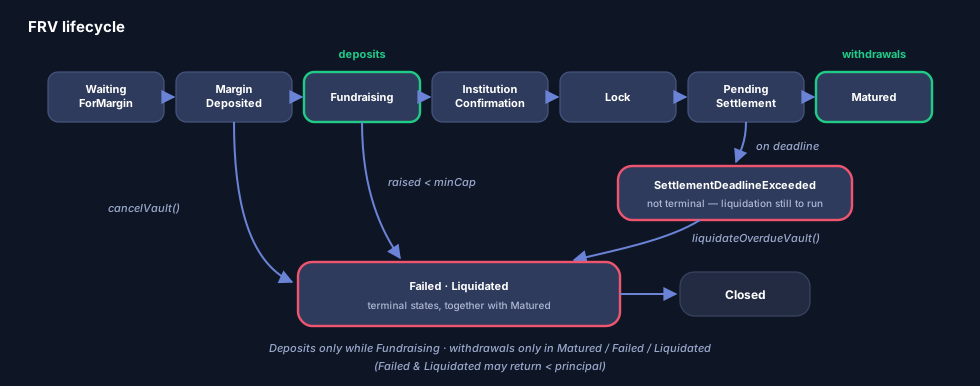
## FRV lifecycle
FRV vaults are ERC-4626 with an **11-state machine** on top. `YieldGroupFRV` calls the vault's permissionless `updateVaultState()` before every **mutating** sizing read — both cascade legs and both targeted `*Resource` legs — so deposit / withdraw routing always acts on current state. Its `accrue()` override pokes every registered vault the same way, so any Hub operation that accrues fees advances the whole family's lifecycle, not only the vault being routed to. The `maxDeposit()` / `maxWithdraw()` **views** are `view` and structurally cannot advance state, so they can report a stale figure until someone pokes `updateVaultState()`.
The full `FRVVaultState` enum (values 0–10): `WaitingForMargin`, `MarginDeposited`, `Fundraising`, `InstitutionConfirmation`, `Lock`, `PendingSettlement`, `SettlementDeadlineExceeded`, `Matured`, `Failed`, `Liquidated`, `Closed`.
* **Deposits** are accepted **only in `Fundraising`** (`maxDeposit` is 0 in every other state). Each vault has a `minSupplierDeposit` floor: a sub-floor cascade leg is skipped to the next vault; a sub-floor targeted `depositResource` reverts `ResourceBelowMinimumDeposit` — *unless* the sub-floor amount exactly fills the vault's remaining capacity (the residual tail), which is always accepted.
* **Withdrawals** are possible **only in the terminal states** `Matured`, `Failed`, or `Liquidated` — capital is locked through `Lock` and `PendingSettlement`. `Matured` adds the fixed-rate yield; `Failed` / `Liquidated` can return **less than principal**, which marks down both `maxWithdraw` and `totalAssets`.
* **Mark-to-model gap.** `AdapterFRV` values a locked position at principal plus the coupon accrued straight-line over the lock, and holds the **full** term coupon flat through `PendingSettlement` and `SettlementDeadlineExceeded` — while `maxWithdraw` stays `0` throughout. That accrued coupon therefore enters `Hub.totalAssets()` and the ERC-4626 share price before it is realized or withdrawable, and it is written down only if the vault settles `Failed` / `Liquidated`. Depositors minting during a lock buy in at a price that includes it; redeemers cannot exit against it until a terminal state.
* Because `maxDeposit()` is a view it cannot advance state, so it can report stale non-zero capacity for a vault that is time-due to leave `Fundraising`; a permissionless `updateVaultState()` poke resolves it. In practice ordinary Hub traffic supplies that poke — every `deposit` / `mint` / `withdraw` / `redeem` / `reallocate` / `accrueFees` runs `YieldGroupFRV.accrue()`, which calls `updateVaultState()` on **every** registered vault, not just the one being routed to. This is a documented honesty-contract caveat, not a fund-safety issue.
## Events
All three YieldGroups emit the shared set below. FRV omits the three `IYieldGroup`-only events (`ResourceCapRaised`, `ResourceCapLowered`, `BlocksPerYearSet`) and is the only one that emits `ResourceForceRemoved`:
| Event | Parameters | Description |
| ------------------------ | -------------------------------------- | --------------------------------------------------------------------------------------------------------------------------------------------------------------------------------- |
| `ResourceAdded` | `resource`, `adapter` | Resource registered alongside its adapter |
| `ResourceRemoved` | `resource` | Resource removed |
| `ResourcePauseToggled` | `resource`, `paused` | Resource pause flag flipped |
| `InnerDepositQueueSet` | `queue` | Inner deposit-routing order replaced |
| `InnerWithdrawQueueSet` | `queue` | Inner withdraw-routing order replaced |
| `DepositRouted` | `resource`, `amount` | Underlying placed into a resource |
| `WithdrawRouted` | `resource`, `amount` | Underlying pulled from a resource |
| `ResourceCapRaised` | `resource`, `newCap` | Per-resource deposit cap loosened (Core / Flux) |
| `ResourceCapLowered` | `resource`, `newCap` | Per-resource deposit cap tightened (Core / Flux) |
| `ResourceAdapterUpdated` | `resource`, `oldAdapter`, `newAdapter` | A resource's adapter was swapped |
| `ResourceSkipped` | `resource`, `isDeposit` | A cascade leg's adapter dispatch **reverted** and was routed around; a healthy system emits this zero times (paused / at-cap / dry resources are skipped silently, with no event) |
| `ResourceAccrualFailed` | `resource`, `adapter` | An adapter's accrual call reverted and was isolated |
| `BlocksPerYearSet` | `oldBlocksPerYear`, `newBlocksPerYear` | Annualisation factor retuned (Core / Flux) |
| `ResourceForceRemoved` | `resource`, `orphanedShares` | Bricked resource evicted, abandoning its shares (FRV) |
| `Swept` | `token`, `to`, `amount` | Stray-token balance rescued |
## Errors
| Error | When |
| ---------------------------------- | ----------------------------------------------------------------------------------------------------------------------------------------------------------------------------------- |
| `NotHub` | An `onlyHub` function was called by a non-Hub address |
| `Unauthorized` | Caller lacked the ACM role for the called function |
| `ZeroAddress` | A required non-zero address parameter was zero |
| `HubAssetMismatch` | The asset at init does not match the Hub's `asset()` |
| `ResourceAssetMismatch` | A resource's underlying does not match this YieldGroup's asset |
| `ResourceAlreadyRegistered` | `addResource` on an already-registered resource |
| `ResourceNotRegistered` | Operation targeted a resource not in the registry |
| `ResourceHasBalance` | `removeResource` while the resource still holds a balance |
| `ResourceIsPaused` | A deposit was routed to a paused resource |
| `ResourceCapacityExceeded` | A **targeted** `depositResource` exceeded that one resource's spare capacity. The inner-queue `deposit` path never reverts on capacity — it partial-fills and refunds the remainder |
| `ResourceLiquidityInsufficient` | Withdraw exceeded aggregate liquid funds across the inner queue |
| `ResourceNotContract` | The supplied resource address has no code |
| `AdapterNotContract` | The supplied adapter address has no code |
| `AdapterUnderfilled` | An adapter delegatecall's observed effect did not match the request |
| `InvalidQueue` | A queue contains a **duplicate** entry (an *unregistered* entry reverts `ResourceNotRegistered` instead) |
| `NotIncreasing` / `NotDecreasing` | A `raiseResourceCap` / `lowerResourceCap` call was not strictly looser / tighter (Core / Flux) |
| `ResourceBelowMinimumDeposit` | An FRV targeted deposit was below `minSupplierDeposit` and not the residual tail (FRV only) |
| `ResourceHasValue` | A force-removal target still holds value that would be abandoned |
| `SweepProtectedAsset` | `sweep` called with the YieldGroup's own underlying |
| `SweepProtectedResource` | `sweep` called with a registered resource's receipt token |
| `WithdrawQueueOmitsFundedResource` | An inner withdraw-queue replacement drops a funded resource |
| `OnlySelf` | An internal dispatch entry point was called externally |
## ACM role strings
Per YieldGroup, the role is `keccak256(yieldGroupAddress, roleString)`.
Shared by all three families (8):
`addResource(address,address)`, `removeResource(address)`, `updateResourceAdapter(address,address)`, `setInnerDepositQueue(address[])`, `setInnerWithdrawQueue(address[])`, `pauseResource(address)`, `unpauseResource(address)`, `sweep(address,address)`.
Core and Flux add three, for **11** in total:
`raiseResourceCap(address,uint256)`, `lowerResourceCap(address,uint256)`, `setBlocksPerYear(uint256)`.
FRV adds one instead, for **9** in total:
`forceRemoveResource(address)`.
---
# Agent Instructions
This documentation is published with GitBook. GitBook is the documentation platform designed so that both humans and AI agents can read, navigate, and reason over technical content effectively. Learn more at gitbook.com.
## Querying This Documentation
If you need additional information that is not directly available in this page, you can query the documentation dynamically by asking a question.
Perform an HTTP GET request on the current page URL with the `ask` query parameter, and the optional `goal` query parameter:
```
GET https://docs-v4.venus.io/technical-reference/reference-liquidity-hub/yield-groups.md?ask=&goal=
```
`ask` is the immediate question: it should be specific, self-contained, and written in natural language.
`goal` is optional and describes the broader end goal you are ultimately trying to accomplish on behalf of the user. GitBook uses it to tailor the answer towards what is most useful for that goal.
The response will contain a direct answer to the question and relevant excerpts and sources from the documentation.
Use this mechanism when the answer is not explicitly present in the current page, you need clarification or additional context, or you want to retrieve related documentation sections.